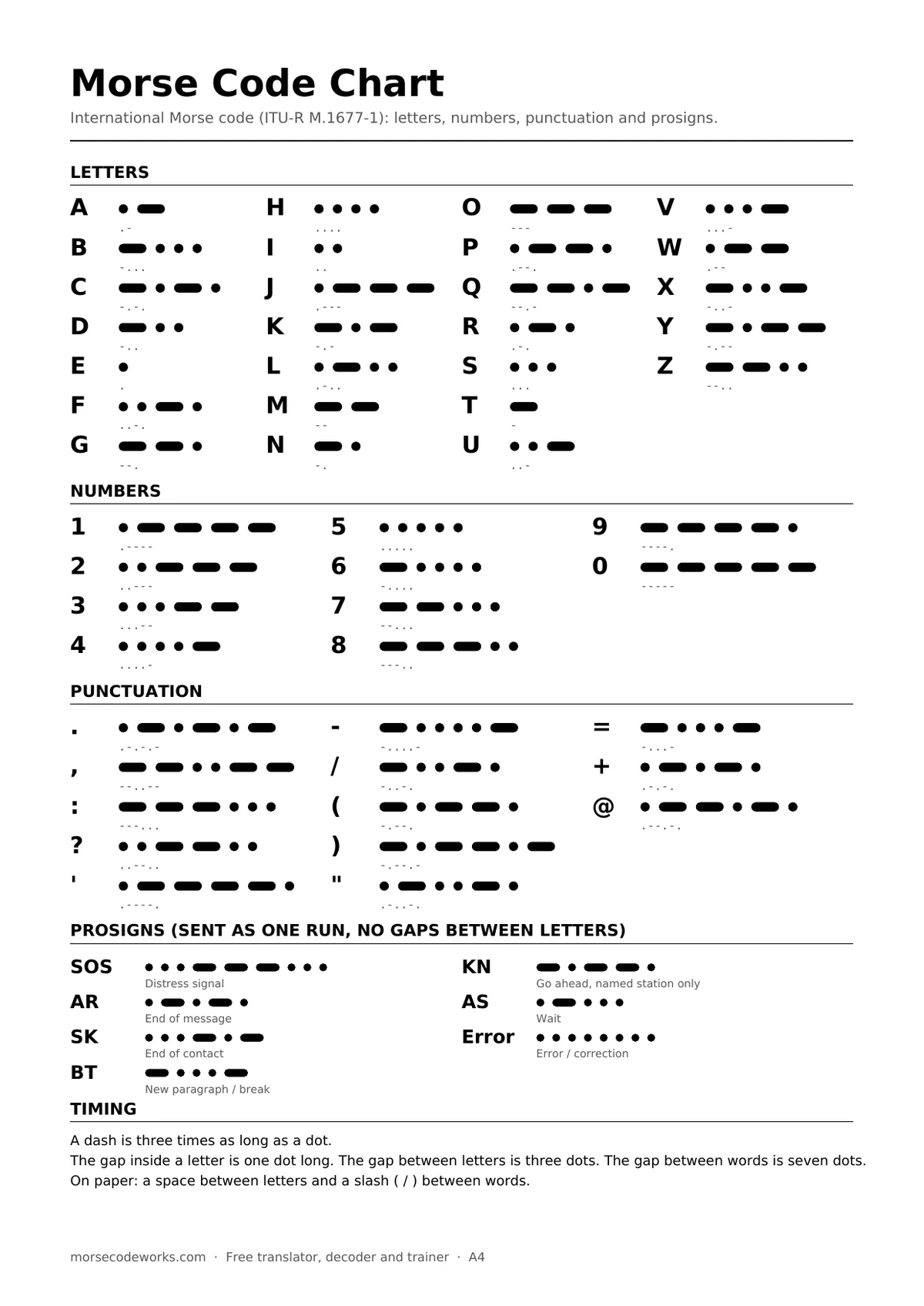
The printable Morse code chart is a free one-page PDF showing the letters A to Z, the numbers 0 to 9, 13 punctuation marks and the common prosigns. Choose A4 for most of the world or US Letter for the United States and Canada, then print it at 100% scale.
Download chart: A4 (PDF) Download chart: US Letter (PDF)
What is on the chart
- Letters A to Z and numbers 0 to 9, the core of the International Morse code.
- 13 punctuation marks from the ITU standard, ITU-R M.1677-1: the full stop, comma, colon, question mark, apostrophe, hyphen, slash, brackets, quotation mark, equals sign, plus sign and @.
- Prosigns such as SOS, AR, SK, BT, KN, AS and the error signal, which are sent as one run with no gaps.
- The timing rule on one line: a dash is three dots long, and the gaps are one, three and seven dots.
Each code is drawn as round dots and long bars, with the dots and dashes typed underneath in small print. The shapes mean it still works in black and white and when photocopied, because nothing depends on colour.
Every code on the chart is generated from the same table the translator uses, so the chart and the tool always agree. Extra characters that are common but not in the ITU standard, such as the exclamation mark and accented letters, are left off to keep it one page. They are on the Morse code alphabet page.
Which size should I print?
Use the A4 file for A4 paper, which is standard in most countries. Use the US Letter file for 8.5 by 11 inch paper. In your print dialog choose "Actual size" or 100%, not "Fit to page", so the dots stay round and the chart keeps its layout.
How to use the chart to learn
A chart is a reference, not a method. You will learn Morse code faster by ear than by looking things up, so use the sheet to check yourself rather than to read from.
- Listen first. Use the Morse code trainer to hear letters at a comfortable speed, and look at the chart only after you answer.
- Learn by pattern families. Some letters are mirror images: A .- and N -.. Others grow by one signal: I .., S ... and H .... are all dots, and T -, M -- and O --- are all dashes. Grouping like this makes the table feel smaller.
- Cover the code. Fold the page so only the letters show, say each code aloud as "dit" and "dah", then unfold it to check.
- Check a message. Type a word into the translator and compare it with the chart. If a code will not read back correctly, how to decode Morse code explains the common spacing mistakes.
The chart lists the common prosigns. For what operators actually say with them, such as CQ, 73 and the Q-codes, read Morse code abbreviations and Q-codes.
Frequently asked questions
Is the printable chart free?
Yes. Both PDF files are free to download and print for your own use, in a classroom or at a club. They carry the site address at the bottom so people can find the translator and trainer. There is nothing to sign up for, and the files do not need any special software to open.
Does the chart include numbers and punctuation?
Yes. It covers the letters A to Z, the numbers 0 to 9 and the 13 punctuation marks defined in the ITU standard. It also lists seven prosigns, including SOS and the error signal. Characters outside the ITU table, such as the exclamation mark and accented letters, are on the alphabet page instead.
Will the chart print clearly in black and white?
Yes. The chart uses only black and grey on white. Dots are drawn as round dots and dashes as long bars, so you can tell them apart without colour. The code is also typed under each symbol in small print. It prints well on a basic laser or inkjet printer.
Should I memorise the whole chart?
Not at once. Most people learn a few letters at a time by ear, adding new ones as the earlier ones become automatic. Use the chart to check your answers rather than to read from. The trainer adds letters in a sensible order for you.